
C4CS analysis
Mind the cap
The Vertically-Integrated Large Energy companies deserve no defense. They pollute the political discourse with rent-seeking nonsense in the hope of skewing the market in their favour.
So it is no pleasure to write what follows. But it has to be said, even if it helps the undeserving:
It is becoming a bien pensant cliche that UK energy prices are high, and that the main cause is market abuse by the "Big Six" energy suppliers (EdF, Centrica, E.ON, RWE, SSE and ScottishPower).
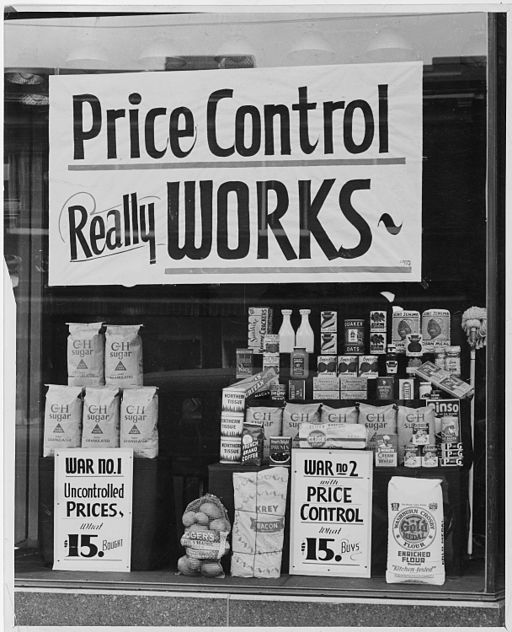
It was reported last month that the UK government is preparing to cap energy prices because "the market isn't working".
Speaking to the Select Committee on Business, Energy and Industrial Strategy on Wednesday, Greg Clark (Secretary of State at BEIS) appeared to confirm that the Conservatives would intervene strongly in the market to control prices if they win the election.


There is an easy test of whether companies are profiteering. Are they achieving persistently-high profits? Profits may not mean profiteering, but the absence of profits is a pretty good indicator that any attempts at profiteering are not succeeding.
The VILE companies sell electricity and gas. Their general profitability does not tell us whether they are profiteering from electricity, gas or both.
Fortunately, they are obliged to provide annual Consolidated Segmental Statements to Ofgem (the energy regulator), which provide an overview of the performance of each main part of their business.
The best measure of the extent of profiteering in the energy sector is the EBIT margin (i.e. Earnings Before Interest and Tax relative to Total Revenue). EBIT is more appropriate than EBITDA for this sector because some of their key investments (e.g. nuclear and renewables) have high capital costs and low running costs, and it is therefore important to take depreciation/amortization into account to get a true picture.
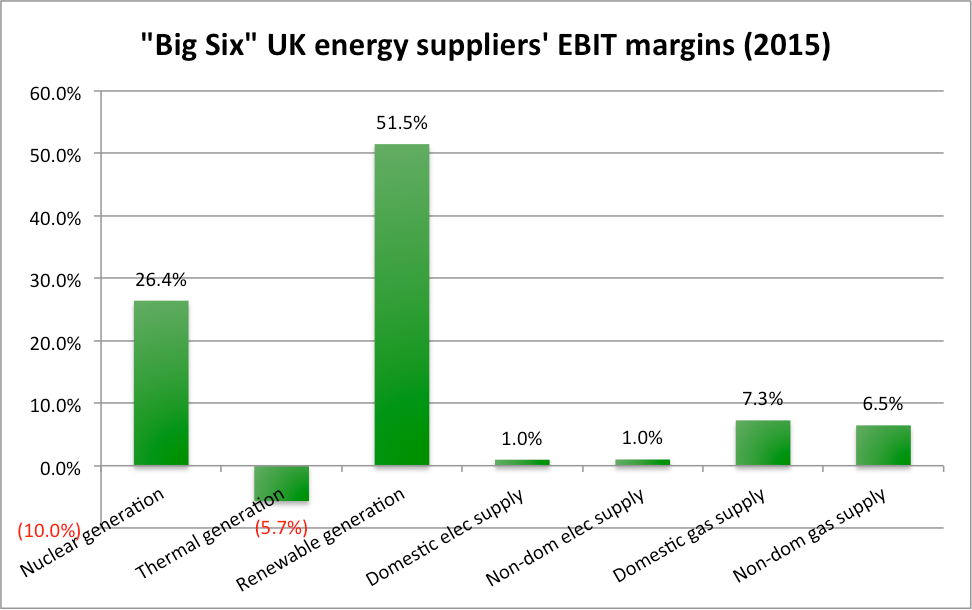
Here is how their EBIT margin breaks down between their main activities.
The VILE companies lose money on conventional power generation, and make minimal margins on the supply of electricity. They make strong margins in two areas:
-
Low-carbon power generation, and
-
Supplying gas.
One might look at their gas margins as a bit higher than one might expect in a mass-market, low-margin product, but
(a) repeated investigations by Ofgem, the Office of Fair Trading and the Competition and Markets Authorityhave failed to find evidence of collusion, and
(b) the outrage at supposed profiteering is provoked mainly by increases in electricity prices more than gas prices:

The only parts of their electricity activities in which the VILE companies are making a lot of profits are the parts whose profitability is determined by the government already: low-carbon generation.
Both nuclear and renewable energy are dependent on government subsidies. If the Big Six are making big profits on these activities, it is entirely because the subsidies are set at a level that delivers those profits. They are the result of government creating a rigged market and handing large amounts of taxpayers' money to the privileged players who are large enough to make the massive investments that technologies like nuclear and offshore wind require, in order to milk the subsidies.
Don't imagine the Big Six are innocent. Who do you reckon employs teams of Public Affairs specialists to influence government policy to this effect?

Rent-seekers will always do this if they can get away with it. Politicians and bureaucrats should be sceptical of lobbying by interest groups, and implement policy on the basis of sound economic principles, rather than "evidence" from self-interested submissions.
But time and again, government implements what big business (usually in cahoots with the academic and bureaucratic establishment) wants, even as it publicly criticizes their profits that its credulous policy-making subsidized.
If suppliers are forced to lower their prices to a level that is easier to withstand for the Big Six (supported by their massive nuclear and renewable margins) than for independents, Greg Clark and Theresa May will unintentionally be helping the VILE companies to undermine their competitors, rather than addressing the real structural issues in the energy industry, which are largely of successive governments' creation.
If they really wanted to do something about profiteering in the energy industry, they would need to look at the excess subsidy that is already locked in, and prevent it getting worse through further increases in the subsidized capacity.
This would have the additional benefit of addressing whole system costs that are escalating because of the increasing imbalance between patterns of demand and inflexible or intermittent production. Environmental levies and whole system costs are the main factors driving UK electricity prices above the market rate.
Will they propose (a) taxes on the profits of over-subsidized nuclear and renewable generation to recoup some of the excess taxpayer funds paid to these companies (addressing the profiteering without penalizing their competitors or breaking the grandfathering principle), and (b) the replacement of the mess of expensive and ineffective mechanisms for the promotion of low-carbon energy with something more economically-rational and less skewed in favour of the massive technologies that only big companies can benefit from?
The answers will probably be "no" to (a), and a pretense of reform on (b) that ends up being equally perverse, just in different ways.