
C4CS analysis
The holy grail of solar heating
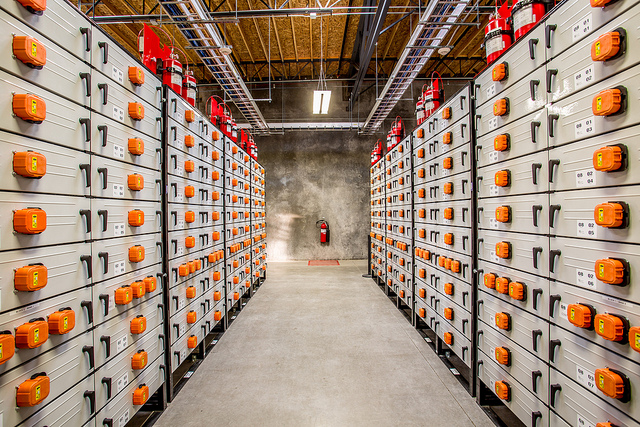
Emily Gosden, The Times' hyperactive new Energy Editor, published an article on Monday about the growing use of batteries to provide system services to the electricity network ("Power shift brings energy market closer to holy grail").
The article was on solid ground describing the stabilizing services for which a system near Leighton Buzzard was commissioned. But it went on to imply that progress on battery costs would lead to this kind of system smoothing out the larger variations in intermittent renewable output:
"To keep the lights on, the system needs flexible power sources that can respond quickly to short-term fluctuations to keep the grid frequency at safe levels, such as the service provided by the UKPN battery. Flexibility is also required to ensure that the grid is not swamped with too much power on a sunny summer afternoon or left short on a dark, still winter evening.
Batteries that can help to overcome renewables’ intermittency by storing power for when it is needed have long been the holy grail of the energy system. Now, thanks to rapid technological advances and cost reductions led by the electric vehicle market, they appear to be within reach."
There is no basis in reality, nor in anything that Emily reported being said to her, to infer that batteries are likely to become a way to deal with seasonal intermittency because they are becoming useful to deal with imbalances over a period of a few hours.
We sent the following brief letter to The Times to try to highlight the non sequitur:
"Sir, Batteries can indeed provide important short-period services to the grid to address problems exacerbated by intermittent renewables. But technologies like solar and wind present longer-period challenges as well.
Our demand for electricity is highest in winter. That pattern will be multiplied if the government continues with its strategy to electrify heat. Yet the output from solar in winter is less than 20% of its output in summer. The output from wind can be depressed for several days or even weeks at a time, and the coldest periods often coincide with low wind output.
Batteries cannot economically "help to overcome" these longer-period intermittency issues. The "holy grail of the energy system" still has to be found."
To understand why electricity storage is unlikely to address the seasonal imbalances between many of our key energy requirements and the production of many low-carbon electricity technologies, see my article on Biomass Heat: The Seasonal Solar Storage Technology.
The figures referenced in the letter to The Times were drawn from the same data that was used for the analysis in that article. The following were the monthly outputs of grid-connected solar generation in summer and winter 2016:
Jan 2016: 194 GWh
May 2016: 1,286 GWh
Jun 2016: 1,115 GWh
Jul 2016: 1,234 GWh
Aug 2016: 1,202 GWh
Dec 2016: 228 GWh
The maximum combined hourly output from onshore and offshore wind in 2016 was 10,042 MW. Between 6 and 25 March 2016, wind averaged 2,361 MW. Between 23 November and 6 December, it averaged 2,556 MW. In other words, for periods of multiple weeks, the output from all our wind turbines was barely one-quarter of its potential.
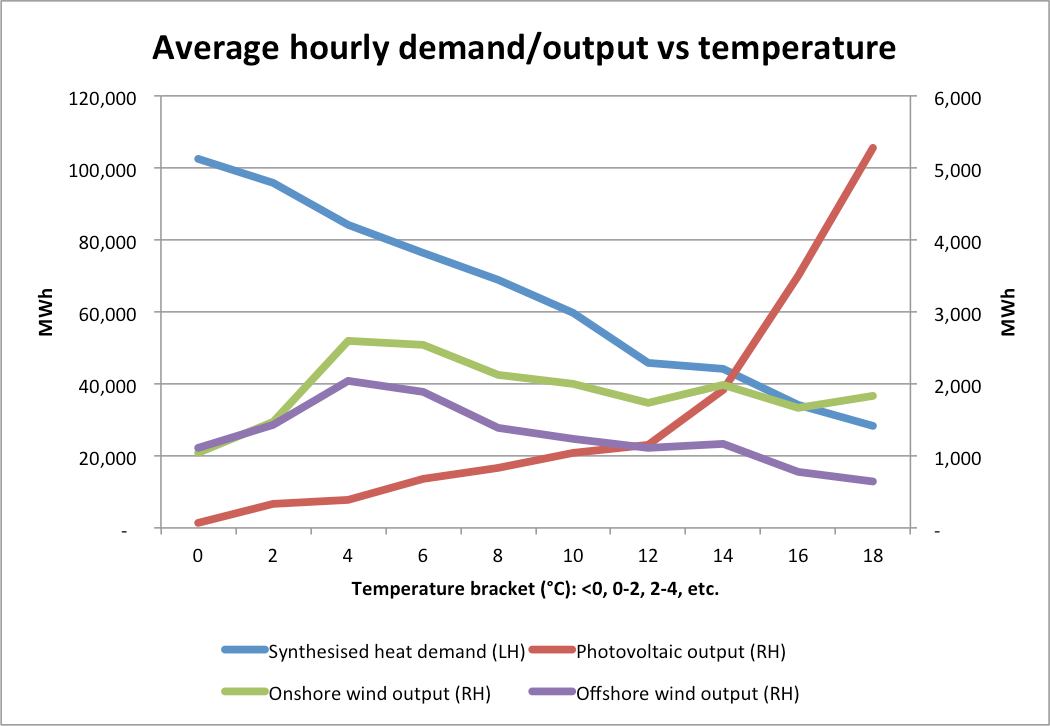
The point about the coincidence of cold periods and low wind output is best illustrated by one of the charts in my "Seasonal Solar Storage" article.
And to illustrate the disparity in scale between the UKPN scheme on which Emily's article was based, and the kind of storage that might be required to address seasonal imbalances, here is an illustration (also from my article on Seasonal Solar Storage) of the surplus or deficit of output from wind, solar and nuclear if we installed 30 GWh of storage (3,000 times more than the UKPN installation) in order to smooth out the imbalances created by decarbonizing one-third of our heat demand by electrifying it and supplying it with output from these low-carbon technologies.
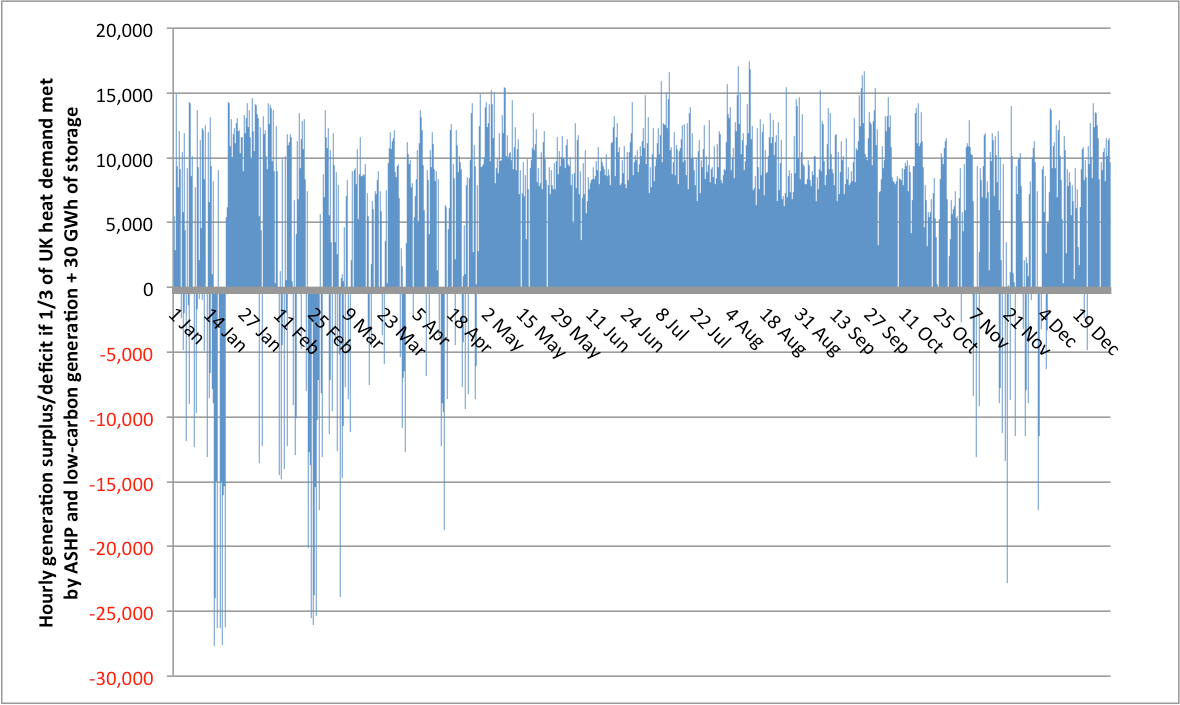
As you can see, even 30 GWh of storage would not be sufficient to avoid the need for 100% dispatchable (i.e. fossil-fired) backup for the low-carbon generating capacity in winter. To supply just one-third of our heat in this way, nearly 30 GW of additional standby generation would be required (roughly as much again as our existing fossil-fired capacity) for the periods in winter when anti-cyclonic conditions and low insolation result in sustained low output of wind and solar. And in summer, most of the output would massively exceed demand, and 30 GWh of storage would be a thimble in which to try to hold this ocean of unwanted electricity.
Of all the absurd things that people propose in order to reduce our carbon emissions, the silliest may be to use solar electricity (which is produced mostly in summer) to supply our heating requirements (which fall mostly in winter). Storage cannot solve this because storage relies on frequent charge/discharge cycles to get sufficient utilisation to cover the capital cost. Seasonal storage would barely get one cycle each year. It is an economic non-starter.