
Report section
2.2.2 Weather
- The external temperature is the most important factor in the levels of heat demand. But the relationship between temperature and heat demand is revealed primarily by comparing temperatures with the use of the primary heating fuel: gas. Unfortunately, unlike electricity, most gas is not metered on a frequent basis. Two academic studies attempted to overcome this by estimating daily profiles that could be applied to the daily figures for gas-use available from National Grid to generate synthetic granular heat-demand data:
-
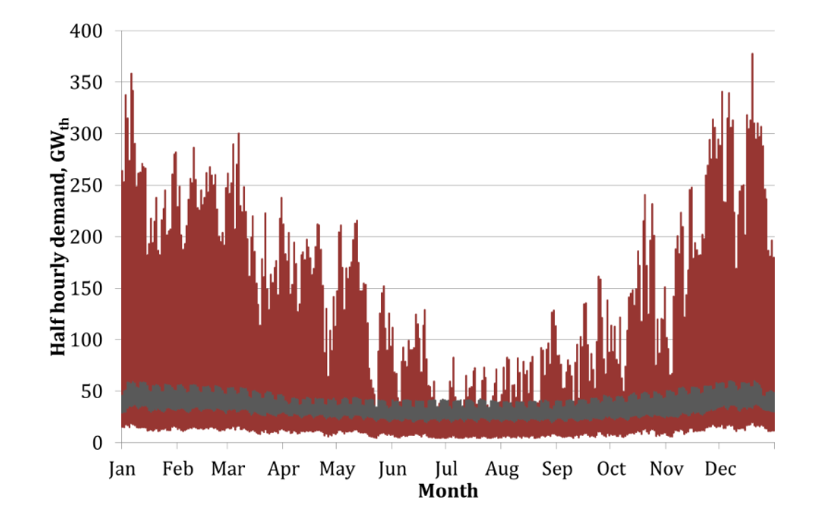 The ground-breaking research of Robert Sansom at Imperial College London generated the first profile of half-hourly heat demand, reflected in the chart to the right that has become famous in energy-policy circles for illustrating the challenge of matching heat demand to inflexible sources:[1]
 -
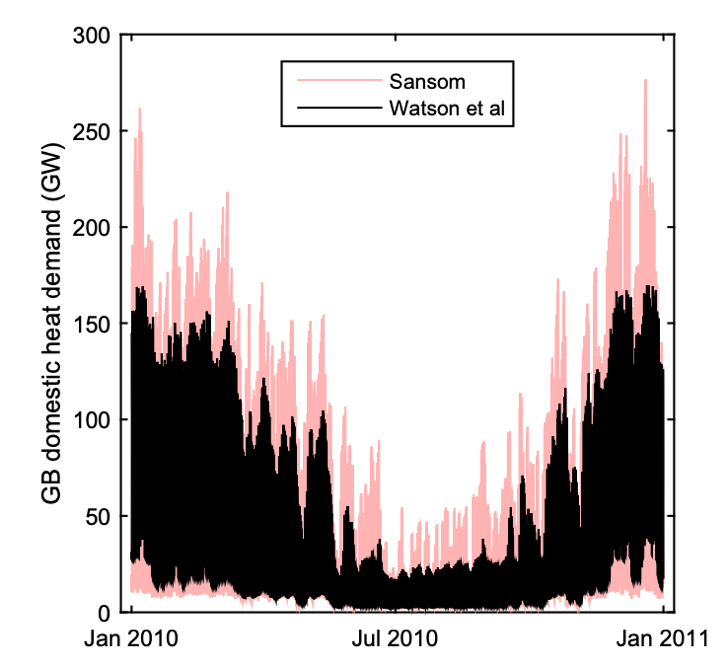 Recently, Watson, Lomas and Buswell of Loughborough University made some well-founded modifications to Sansom’s model that reduced its “peakiness”.[2] The observation that heat demand would be spread more widely over the day in cold conditions with high demand (rather than simply increased pro rata in each period) is both intuitive and consistent with the large dataset that they used. The difference with Sansom is illustrated in the chart from their paper to the right.
We adopted their “less-peaky” heat-demand profiles to convert National Grid’s daily gas-demand figures into reasonable synthetic hourly figures.[3] The somewhat-flattened profile reduces the balancing challenge, but comparing the two charts above should illustrate that heat demand remains significantly larger and more variable than electricity demand (the grey line in Sansom’s chart).
-
- Temperature is important not only to the heating demand, but also to the cooling demand. This is currently modest in the UK, but is a key determinant of the demand profile in hotter countries, and is likely to become more significant in the UK if the climate warms and if we wish to reduce the number of excess deaths during hot periods. Data are limited, but we have an estimate of the capacity of non-domestic air-conditioning units (a large proportion of the total) from the work done to estimate the contribution of “RAAHPs” (see above) to our renewable heat. We may assume their output for their primary purpose, cooling, is also significant, but have to adjust for the fact that the estimated heat is not the electricity consumption, but the large figure assumed to be produced on the basis of their heating sCOP. Very roughly, this suggests an equivalent usage in summer that might amount to 5 TWh of electricity (1.7% of total electricity demand). It is unlikely to be more, because even this small amount would be quite prominent in the electricity demand figures for the limited number of periods that require cooling in the UK. We allocate this total (which is an input that can be adjusted in the model) to hourly periods according to the extent the temperature exceeds a threshold temperature for cooling, on the basis of Met Office hourly temperature data.[4] We then subtract these synthesised figures from the electricity demand figures, to estimate the demand for conventional uses (lighting, equipment etc) so that the combined total is consistent with Elexon’s demand figures.
- The wind is another key weather input, as wind power is expected to play such a large part in the UK’s future electricity supplies. Fortunately, half-hourly electricity data are available in a cornucopia of details from Elexon’s website.[5] Wind output from Elexon is better as seed data than any figure for UK wind speeds, as it reflects the reality of where wind farms are actually located, and how their output responds (not linearly) to wind strength.
- UK solar capacity has become large enough for insolation to be another important weather variable. Figures for solar power connected to the transmission network are also available from Elexon, but this is complicated by the fact that the majority of solar is embedded. That has a double effect:
- The available solar figures do not reflect national output, and
- The embedded solar is treated as negative demand and affects Elexon’s demand figures
However, the profile of grid-connected solar output is probably reasonably reflective of the profile of total solar output (although the embedded solar is probably somewhat less optimally positioned on average). So we can use Elexon’s solar figures for the hourly solar profile whilst discarding the absolute figures as only a fraction of the true figure. In our model, we treat solar as one homogeneous lump of capacity (undifferentiated as grid-connected or embedded), and likewise electricity demand as a gross figure exclusive of any embedded power, to minimise complexity. That means that the model figures for electricity demand will not match the metered figures and the figures in national statistics. But reverse-engineering these figures (by applying the solar profile to an estimate of embedded capacity based on subtracting the public figures for total capacity from Elexon’s figures for grid-connected capacity) should be reasonably accurate, and produce the same net effect.
- We do not incorporate other weather factors, such as rainfall, which have some impact (e.g. on hydro output and heat demand). These should be internalised approximately in the figures we use to estimate these components.
[1] https://spiral.imperial.ac.uk/bitstream/10044/1/25503/1/Sansom-R-2015-PhD-Thesis.pdf
[2] https://www.sciencedirect.com/science/article/pii/S0301421518307249#bib29
[3] https://mip-prd-web.azurewebsites.net/DataItemExplorer
[4] We extracted this data while the Met Office had made their APIs freely available to the public, enabling us to download hourly data for their measurement points around the country. Unfortunately, they closed the public access in 2019, which is why our model uses data for the years 2016-2018, which were the years for which we obtained complete datasets before the API was closed.
[5] https://www.bmreports.com/bmrs/