
C4CS analysis
Raking over the coals

We are constantly told that the cost of renewable electricity generation has fallen so far that it is now cheaper than coal- and gas-fired generation. That seems strange when the retail cost of electricity has been heading ever upwards as the share of renewables in the electricity mix has increased.
The claims are based on calculations of the Levelised Cost of Electricity. LCOE is intended to give a single figure in terms of cost per unit of electricity generated that encapsulates the capital and running costs.
There are many things wrong with LCOE. In particular, it excludes system and distribution costs, which are affected significantly by the generation technology mix. But even on its own terms, something looks fishy with the figures commonly presented.
Our World in Data is a fantastic resource. But occasionally it is hoodwinked by the Establishment narrative.
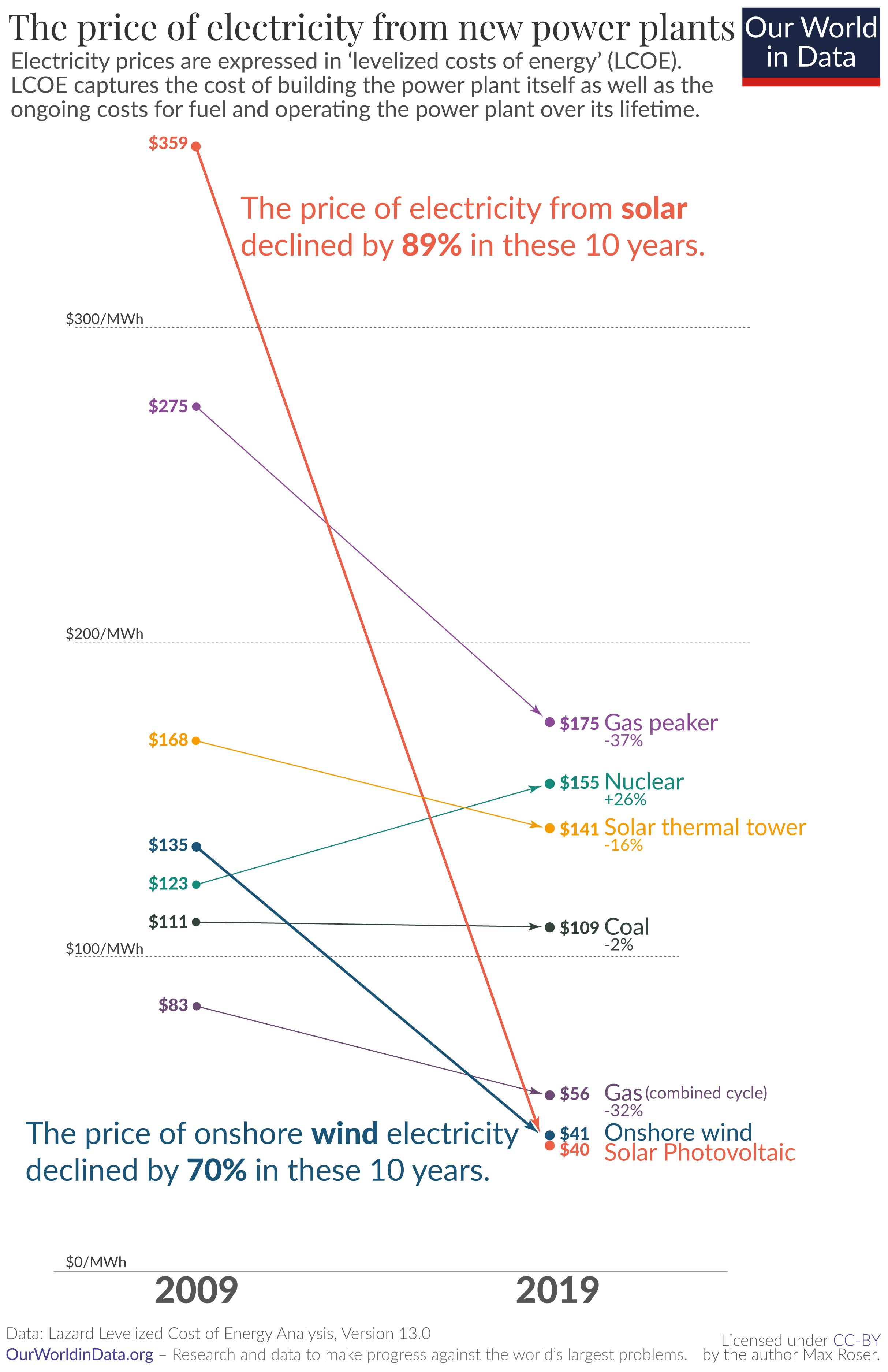
On the question of generation technology costs, they produced a chart that reflects the Establishment view. Recursively, it is used by the Establishment as evidence of the validity of this comparison, leaning on OWiD's strong reputation, as argumentum ad auctoritatem.
For instance, Paul Krugman used a simplified version of their chart in a recent Op-Ed in the New York Times. Such is Krugman's consistent attraction to fallacies that I would immediately check anything of mine that he quoted.
Even without looking at individual figures, something stinks about the presentation of this data. Two sets of data points are taken: estimates for 2009 and 2019, and a straight line is drawn between them to imply a trend. This is not an appropriate way to show two sets of data. If you want to draw trends, incorporate more periods. If you've got two periods and don't want to mislead, use a barchart or something else that doesn't imply an intervening trend.
The Global Warming Policy Foundation and the Renewable Energy Foundation have dismantled such claims on the cost of wind and solar electricity. But it struck me that the coal "trend" warranted some exploration as well.
Not that long ago, coal was widely understood to be a cheap way to produce electricity, until you factored in the cost of carbon. But this chart says it's not only expensive now, but was also expensive a decade ago. Really?
2009 is artfully chosen as a starting point, because there was a significant upsurge in coal costs in the second half of the noughties. The fuel got a lot more expensive. And the introduction of the European Union Emissions Trading Scheme added a cost of carbon for the first time.
Even so, the average daily wholesale cost of electricity in 2009 was £38/MWh. How could that be when gas and coal made up the majority of our electricity and they cost (according to OWiD, Krugman, Lazard etc) $83-275/MWh and $111/MWh respectively? Most of the rest was nuclear, which was apparently $123/MWh.
This is not explained by a difference between the UK and the US. EIA data for wholesale spot electricity prices put the 2009 average around $35/MWh. That's an even bigger discrepancy with OWiD's LCOEs. Coal, gas and nuclear generation were similarly dominant in the US at that time.
How can the wholesale price to actually buy electricity from generators be a fraction of the theoretical cost (LCOE) of producing that electricity? Because LCOE is bullshit and so is analysis based on it; that's how.
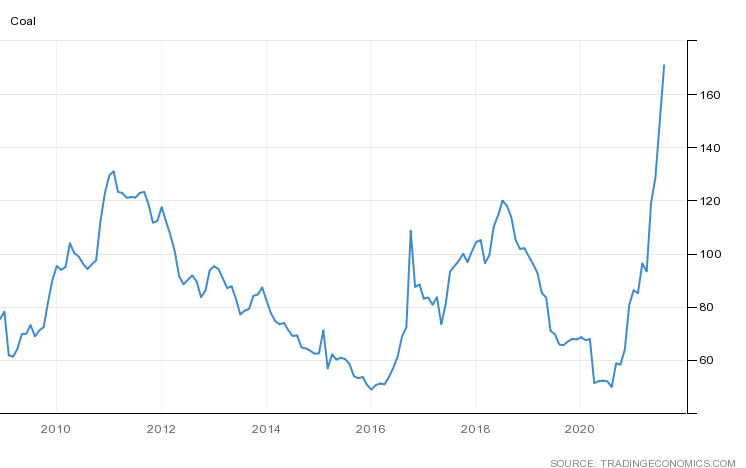
Here's another way of judging what a load of cobblers that analysis is. Fuel cost is a major component of the cost of fossil-fired electricity. Here is how the cost of coal has varied ($/ton) since 2009. Assuming a calorific value of around 8.5 MWh/ton and a conversion efficiency of around 37%, at $50/ton, the fuel cost component in the electricity is $16/MWh. At $150/ton, the fuel cost component is $48/ton. But we are asked to believe that the cost of coal-fired electricity varied by $2/MWh, from $111/MWh in 2009 to $109/MWh in 2019.
Over a 30-year lifespan, the capital cost of a coal-fired generating station is a relatively small proportion of the overall cost. Other operating costs are also not that significant. It is no accident that the wholesale price of electricity was around the middle of the range of fuel costs for the largest component of that electricity.
The cost of carbon signifies in the cost of coal-fired generation, but LCOE does not include a carbon value. It is one thing to argue that low-carbon generation is cheaper when you take into account the social cost of carbon emissions, but another to argue that it is cheaper anyway regardless of the cost of carbon. In the former case, society still has to incur the cost of decarbonisation in the short-run, on the assumption that it is a net benefit in the long run. In the latter case, there is no cost to decarbonising electricity. The green blob want us to believe it, but it's palpable nonsense. There is a reason why low-carbon electricity needs a lot of subsidy.
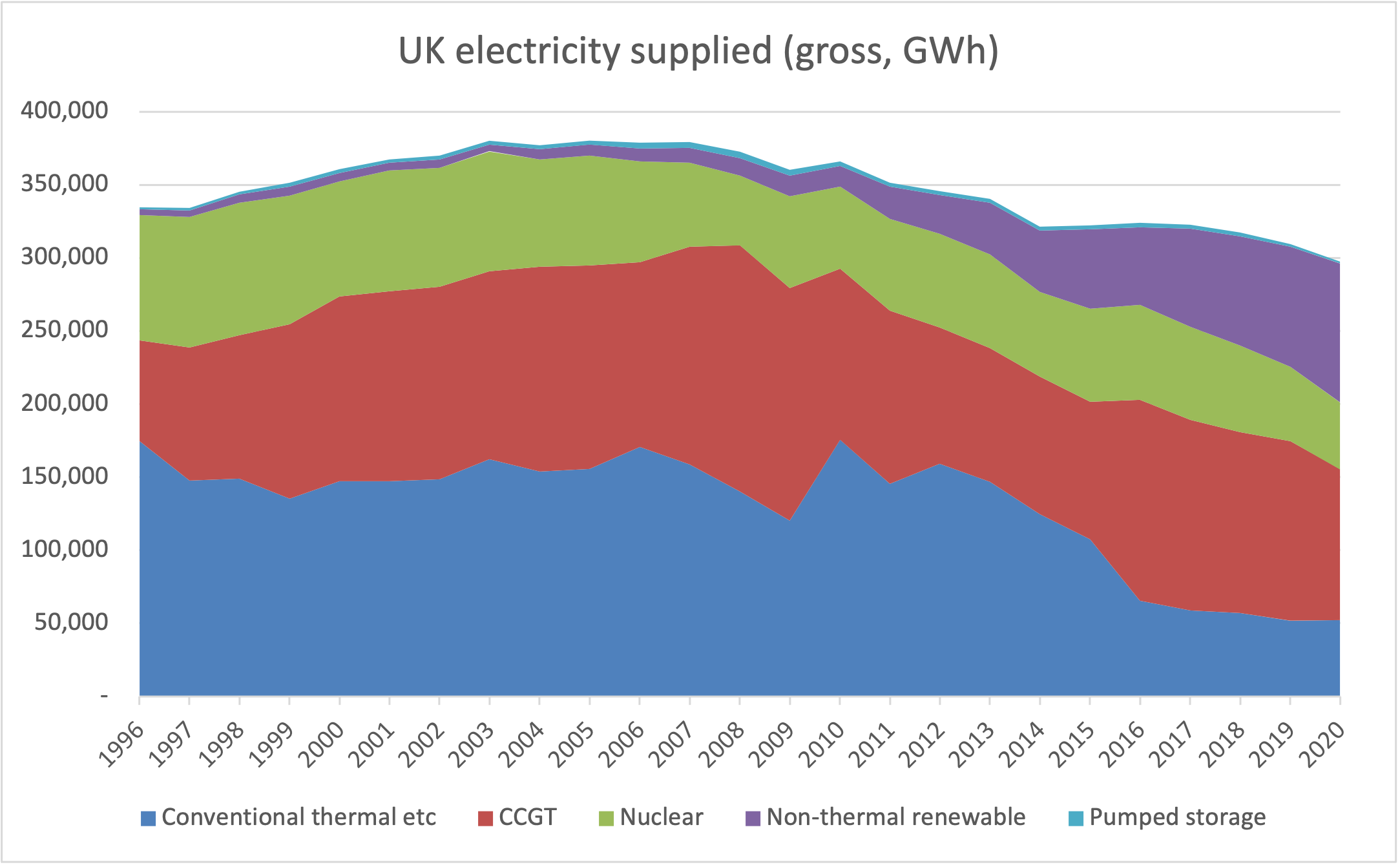
It is hard to square the LCOE with the cost of electricity to its users (the retail price). The only technology that has increased in cost is nuclear, but there has been no new nuclear and its share has been falling in the UK. Everything else has been static or falling in cost.
The technologies whose shares have increased the most are those whose LCOE has supposedly fallen the most (the following charts use BEIS's Historical Electricity Data). If LCOE represented reality, this ought to add up to significant reductions in the cost of electricity.
Instead, the cost of electricity to consumers has risen significantly since 2009, and even more so since the mid-2000s.
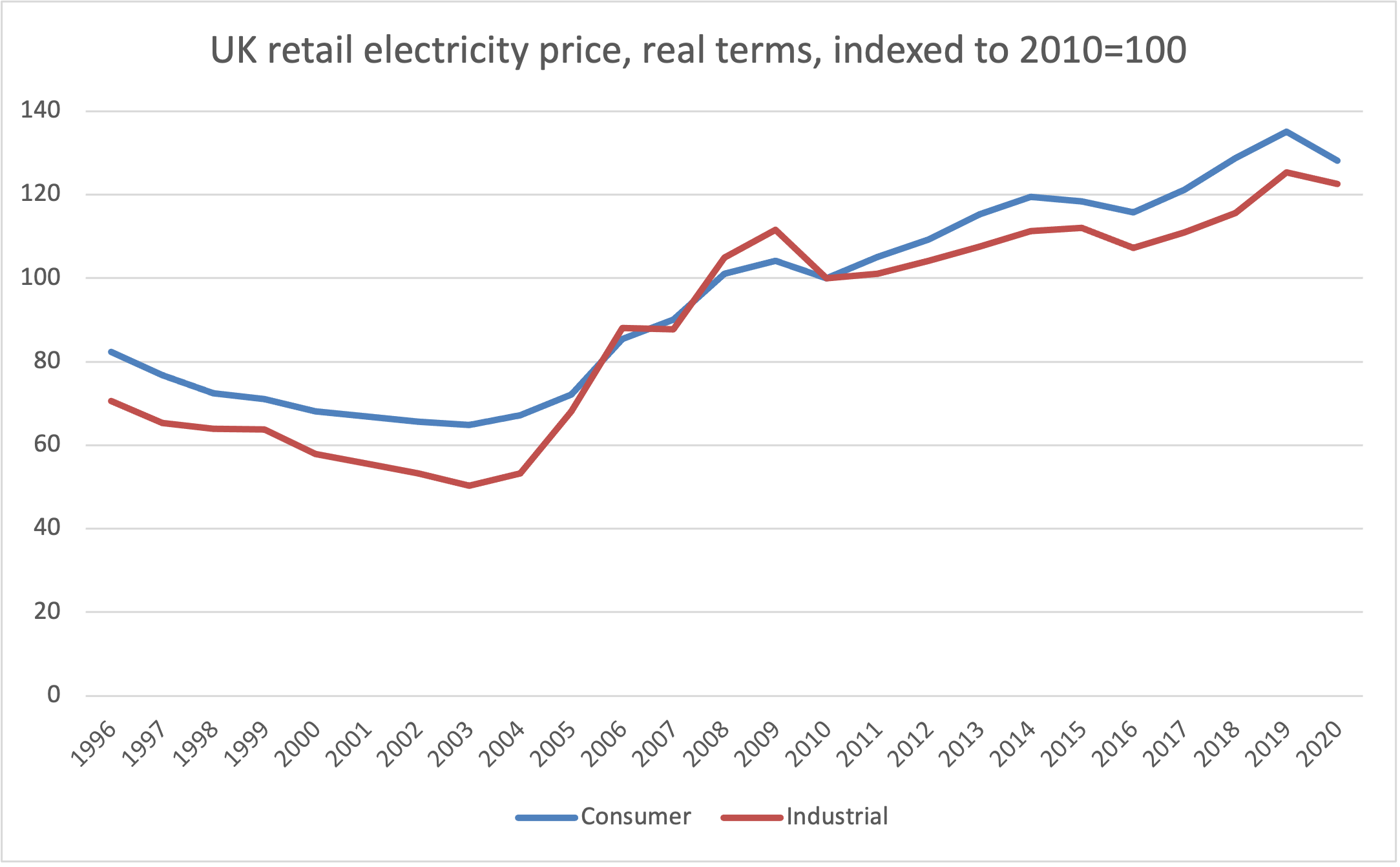
BEIS's data are unfortunately not in actual price (p/kWh or £/MWh) since 1990, but in values indexed to 100 in a particular year (2010 in this chart). This is presumably an unintended consequence of the privatised market structure.
But they are in real terms, so a doubling in the chart means a real-terms doubling in the price. Electricity has more than doubled in cost to consumers since 2003, in real terms.
BEIS offer data back to 1920, so to round this off, let's see how the long-term trend looked.
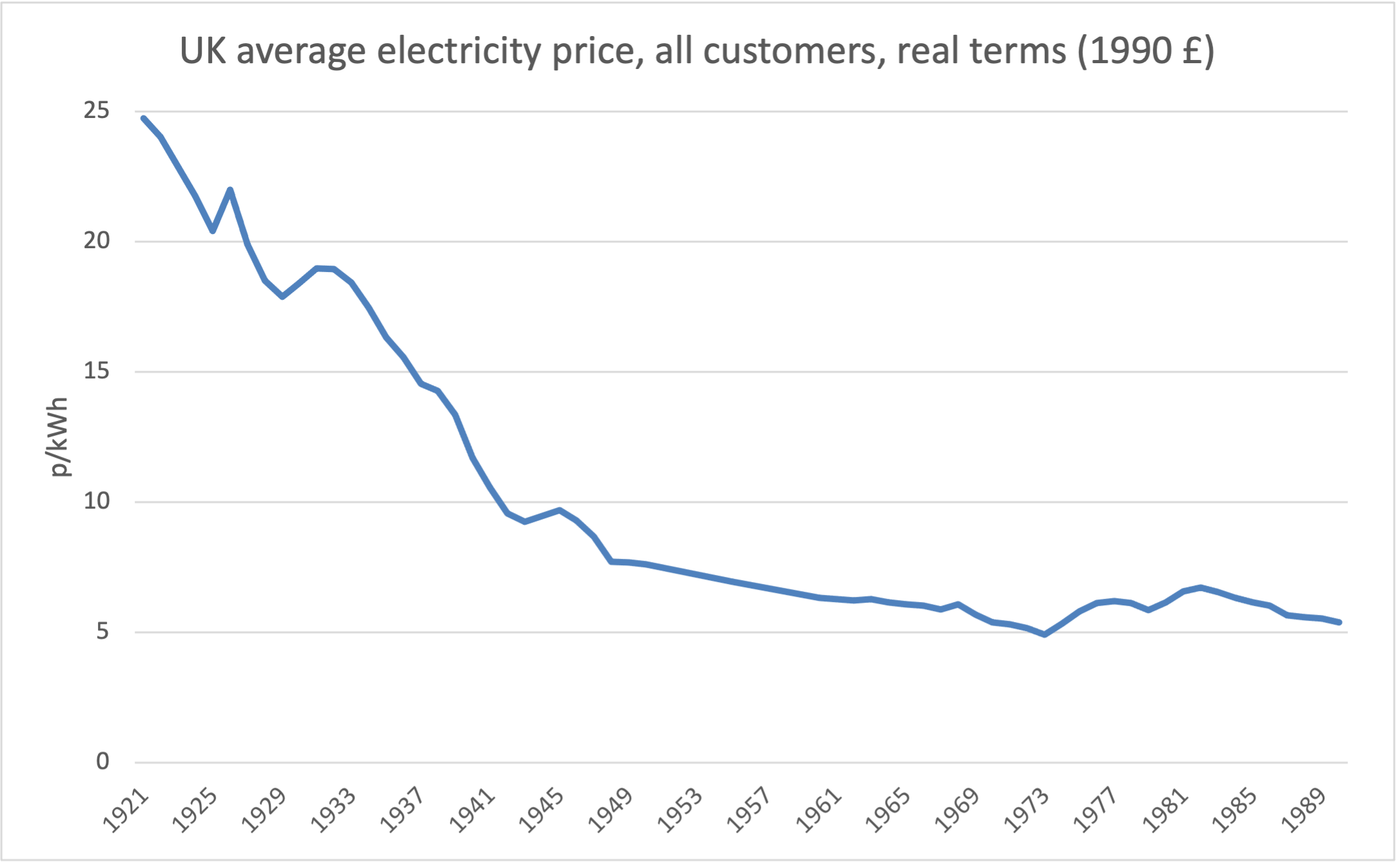
Real prices (p/kWh) are available upto 1990. These are adjusted to 1990 £, to show real-terms (i.e. directly comparable) values.
The history of electricity in the twentieth century was, by-and-large, one of continuous cost reductions (apart from the Oil Price shock and nationalised sclerosis of the 70s).
The history of electricity in the twenty-first century has so far been, and looks set to be, one of rising costs. LCOE is not a true indicator of cost. It's an academic fiction, invented to try to fool people for as long as possible that cheap things are expensive and expensive things are cheap, by highly selective choice of system boundaries and data.
Trust markets, not academics, consultants or bureaucrats, to tell you true costs.