
C4CS analysis
Biased BP

BP's Statistical Review of World Energy is widely used as a reference source for energy statistics. Sadly, it turns out that BP's bias as an oil company leads it to categorise energy in such a way that it distorts the data badly.
I noticed this when I was looking for a reliable source to illustrate the insignificance of wind and solar in the Swedish energy mix. Our World in Data is normally an excellent resource, but something about their chart of Swedish energy consumption by source didn't look right.
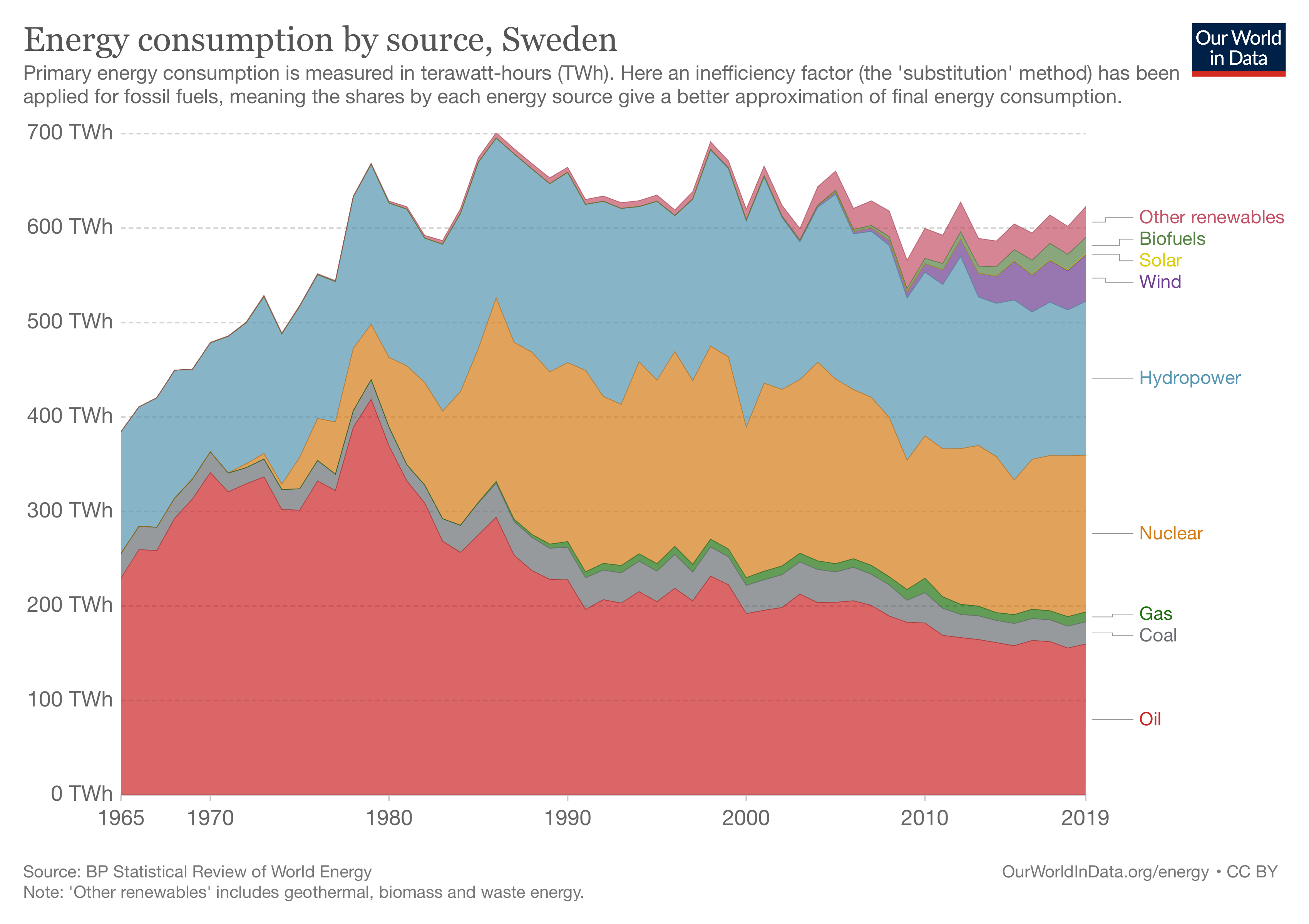
Anyone who knows Sweden knows that biomass is one of their major primary energy sources. Yet in this chart, there is a small contribution from biofuels, and biomass is otherwise subsumed within the similarly insignificant "Other renewables" category.
Our World in Data get their data for this chart from BP's Statistical Review of World Energy (their data, referenced below, is downloadable here [XLSX]). Biomass appears negligible in this chart because BP treat primary energy sources as follows:
- Biofuels (i.e. bioethanol and biodiesel) are treated as a separate category from other biomass. Biofuels are not a significant category in primary energy consumption in Sweden as in most countries. They are presumably treated separately by BP, despite being the least significant use of biomass, because they are an oil company with a transport-fuels bias.
- Other biomass is lumped in with "Geo Biomass Other" in BP's data, which Our World in Data shorten to "Other renewables".
- "Geo Biomass Other" is a category for electricity generation, not all energy uses. Their first sheet "Geo Biomass Other - TWh" lists electricity production from these sources. Their second sheet "Geo Biomass Other - EJ" lists the "Exajoules (input-equivalent)", i.e. the amount of input energy estimated to produce the electricity in the previous sheet.
- This completely omits the use of biomass for heat, which is its primary use in Sweden as in many countries. Biomass and waste accounted for almost a quarter of the Swedish energy supply in Sweden in 2013. District heating supplies 60% of all heat in Sweden, and almost half of that heat comes from biomass. Biomass also makes a material contribution to the other (direct) 40% of heat.
BP's bias in this regard will be replicated wherever biomass heat is a material contributor, which is most of the world. I wonder how widely this skew is replicated in analysis that relies on BP's data?